





Best Tesla Accessories For Owners Who Park Outside Every Day

Does your Tesla’s daily ordeal really end once you lock it? Without the protection of a garage or carport, a vehicle parked on the street, in an apartment parking lot, or on a private driveway remains exposed to sunlight, rain, temperature fluctuations, and airborne debris. These seemingly minor effects gradually accumulate through day after day of outdoor parking.
For Tesla owners who park outside every day, the most worthwhile accessories include windshield sunshades, weather-resistant exterior accessories, glass-care tools, charging-port aids, environmental inspection tools, and portable emergency supplies. The key consideration is not how many features an accessory offers, but whether it can reduce the practical effects of heat, rain, dust, impaired visibility, charging disruptions, parking blind spots, and unexpected breakdowns.
The most effective choices begin with understanding how outdoor parking changes the vehicle’s condition and everyday use, and then determining which accessories deserve priority.
What Ongoing Problems Can Daily Outdoor Parking Cause For A Tesla?

Daily outdoor parking continually exposes a Tesla to temperature extremes, rain and snow, accumulated airborne pollutants, and unexpected interference in public parking environments. It can also increase the time required to inspect and prepare the vehicle before departure.
These problems do not occur in isolation: high temperatures affect comfort when first entering the vehicle, precipitation and windblown dust alter the vehicle’s condition, and an outdoor parking space cannot shield it from constant environmental changes.
They are described as “ongoing problems” because the exposure is repeated, while its effects may not be addressed promptly.
A single period of intense sunlight, rainfall, or dust is usually manageable. However, when a vehicle remains outdoors day after day, small problems may continue to accumulate before the owner notices them. The longer the parking duration and the more frequently the weather changes, the more likely occasional inconveniences are to become routine burdens.
Public parking environments can further intensify this cumulative effect.
Nearby vehicles, pedestrians, construction work, standing water, and falling objects constantly introduce new variables. Some issues are immediately visible, while others only become apparent the next time the vehicle is used. In such circumstances, owners must not only deal with problems that have already occurred but also accept the uncertainty of being unable to predict the vehicle’s exact condition.
For this reason, the real cost added by outdoor parking is not a one-time inconvenience, but recurring friction that consumes time and attention throughout the year.
Which Parts Of A Tesla Are Most Affected By Outdoor Conditions?

Long-term outdoor parking primarily affects a Tesla’s glass, body paint, door handles, charging port, cameras, seals, and cabin environment. The extent varies depending on the model, climate, and parking duration; being affected does not necessarily mean that damage has occurred.
Glass: The windshield is essential for driving visibility, while the glass roof can increase the amount of heat entering the cabin.
Body Paint: The paintwork has a large exposed surface area, and color contrast can make localized residue more noticeable.
Door Handles: Owners operate the handles repeatedly every day, so changes in their condition are often noticed first.
Charging Port: The port connects to an external power source, and its operating environment also includes the plug, cable, and surrounding ground.
Cameras: Although the lenses are small, even partial obstruction can noticeably reduce image clarity.
Seals: Moisture and fine residue can collect around the edges of doors and windows.
Cabin Environment: The glass and body transfer some external heat into the cabin, affecting passenger comfort.
Overall, outdoor conditions do not affect the entire vehicle evenly: larger surfaces experience more exposure, while smaller functional areas are more sensitive to localized changes.
How Should Owners Without A Garage Prioritize Accessories?

Owners without a garage should first identify which problems genuinely require an accessory and then compare the practical burden of using different products. The highest-priority accessories should address frequent, unavoidable issues that consistently affect everyday vehicle use.
First, record parking and driving conditions for one to two consecutive weeks, then organize the problems according to their frequency and severity. A list based on real-world conditions is more reliable than one based on product marketing or isolated weather events.
Once the list is complete, determine which problems can be resolved by changing the parking location, timing, or driving habits. Issues that can be eliminated at no cost should be excluded, leaving the budget for needs that cannot be reliably avoided.
Next, when an issue genuinely requires an accessory, owners should confirm that the product matches the vehicle model, production year, and original vehicle structure, while also considering the additional steps required for installation, removal, and storage. The more complicated the process, the less likely the product is to be used consistently over time.
Finally, once compatibility and convenience have been confirmed, compare the value each product provides over a full year. Keep only one primary solution for each frequent problem to avoid overlapping functions. Priority should therefore depend not on the number of products purchased, but on whether each accessory can reliably reduce the practical burden of everyday vehicle use over the long term.
Which Tesla Accessories Best Address The Practical Problems Of Outdoor Parking?

Tesla owners who park outside every day are best served by six categories of products: cabin heat protection, localized weather protection, visibility restoration, cable management, environmental inspection, and temporary emergency supplies. Owners can use them at different stages of parking, charging, inspection, and departure, with each category handling one clearly defined task.
|
Accessory Category |
Specific Item |
How It Is Used |
Practical Benefit |
|
Cabin Heat Protection |
The owner unfolds the sunshade after parking |
Reduces solar heat entering through the windshield |
|
|
Localized Weather Protection |
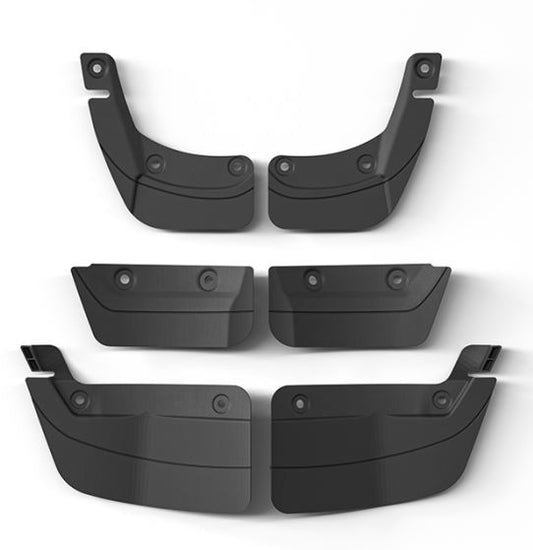
Windshield snow and ice cover, localized splash guards |
The owner installs them before expected weather changes |
Isolating designated areas reduces direct contact with snow, ice, or splashing debris |
|
Visibility Restoration |
Glass squeegee, microfiber cloth, de-icing tool |
The owner clears the main viewing areas before driving |
Quickly restores visibility without requiring the entire vehicle to be cleaned |
|
Cable Management |
Cable hanger, routing device, reflective markers |
The owner plans the cable route when connecting the charging cable |
Keeps the cable secured in a defined position and makes it easier to see at night |
|
Environmental Inspection |
Rechargeable flashlight, magnetic inspection light |
The owner illuminates the surrounding area when approaching the vehicle |
Allows a quick check of the area around the vehicle, the ground, and the charging cable |
|
Temporary Emergency Supplies |
Compatible inflator, warning equipment, protective gloves |
The owner performs basic on-site measures when an abnormality occurs |
Provides immediate warning at the scene and allows minor problems to be handled temporarily |
These six accessory categories serve different purposes.
The owner is responsible for deploying and operating them, while critical areas are insulated, illuminated, organized, or temporarily treated when needed. This prevents the unnecessary purchase of multiple products with similar functions.
How Should Accessories Be Combined And Maintained For Long-Term Value?

Owners should first consider how different accessories work together and then establish routines for cleaning, storage, inspection, and retirement. A sensible combination prevents products from interfering with one another, while consistent maintenance keeps them in reliable condition.
First, check whether different accessories compete for the same installation space, press against one another, or require conflicting procedures.
When removing one product requires moving two others first, the arrangement is creating unnecessary steps, and the owner should reorganize the installation and storage locations.
Second, assign a fixed storage method to every accessory.
Dry items should be stored separately from damp ones, while cables, folding items, and loose components should each have clearly designated places.
Third, establish maintenance procedures based on product construction.
Owners should inspect soft items for cracking, delamination, or loss of elasticity, check hard items for deformation, and test clips and connection points. Powered devices should be recharged regularly, while the remaining quantity and expiration dates of consumable supplies should also be recorded.
Fourth, keep a brief condition log so that problems can be identified before complete failure occurs.
Fifth, establish clear retirement criteria.
Accessories that cannot return to their original shape, no longer connect securely, have missing parts, or provide unstable output should be removed from use promptly. Long-term value does not mean forcing a product to remain in service for as long as possible; it means ensuring predictable performance every time the product is used.
FAQ
1. Is Parking A Tesla Outside Every Day Bad For The Vehicle?
It will not necessarily damage the vehicle, but it increases the frequency of exposure to sunlight, rain, temperature changes, and debris. Owners should adjust their inspection habits according to the parking environment.
2. Do Tesla Owners Need To Use A Full Car Cover?
A full car cover is generally unnecessary for a vehicle used every day. It may be considered during long periods of inactivity, but owners should assess strong winds, moisture, installation time, storage burden, and the surrounding parking environment.
3. Which Accessories Are Suitable For Teslas Parked Outside?
Suitable options include practical categories such as sunshades, glass-care tools, weather-resistant exterior products, charging-cable management devices, lighting tools, and emergency supplies.
4. How Does Outdoor Parking Affect Everyday Tesla Use?
Outdoor parking increases the need for pre-departure inspections and careful parking decisions. Owners may need to check the glass, cameras, tires, charging area, and surrounding ground.
5. Can A Tesla Be Parked Outside Year-Round?
Yes. Under normal operating conditions, a Tesla can remain parked outside throughout the year, but owners should adjust their vehicle-use habits according to local weather and ensure that accessories do not obstruct any of the vehicle’s original functional areas.
Conclusion
Outdoor parking is a long-term vehicle-use environment. Owners do not need to pursue complete isolation from external conditions. A more practical approach is to identify recurring problems, establish simple routines, and choose Tesla accessories that are easy to use consistently.
TESPEX offers everyday outdoor accessories compatible with Tesla vehicles and is currently providing a 5% early-order discount. For product compatibility and ordering details, please contact info@tespex.com.au.